
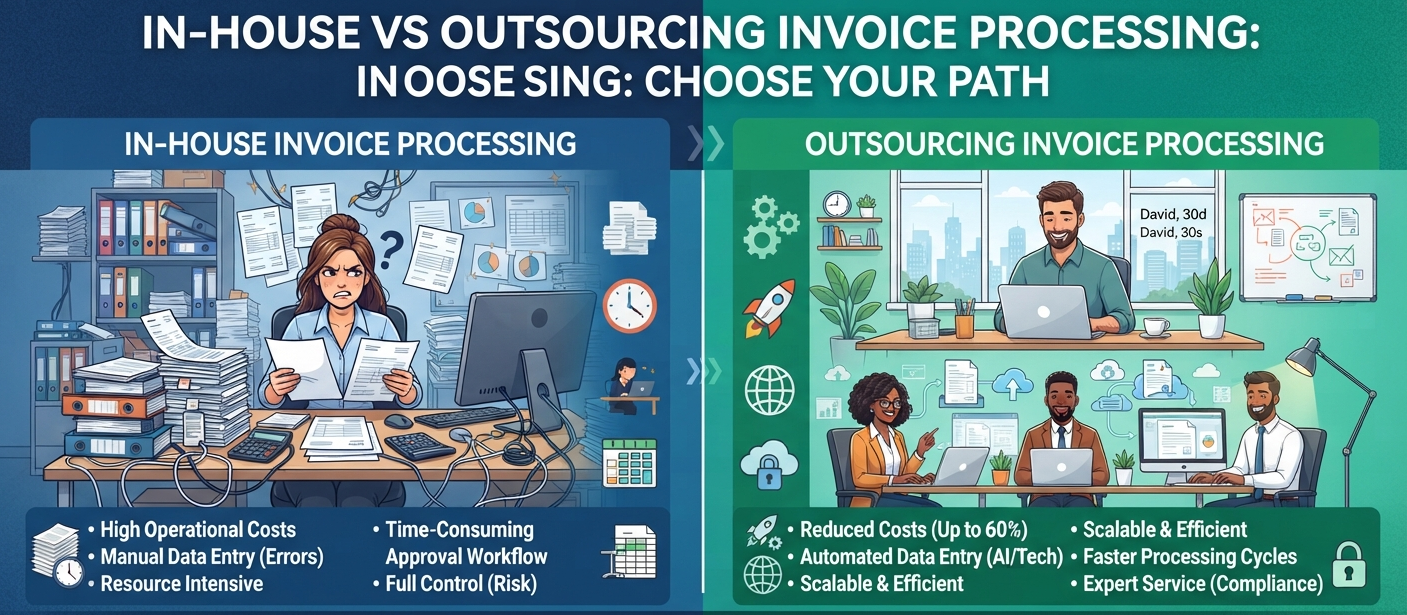

In-House Invoice Processing vs Outsourcing
Every growing business eventually reaches a financial crossroads: how to manage the escalating volume of accounts payable paperwork without draining company resources. Invoice processing is a critical back-office function, yet it is notoriously manual, time-consuming, and prone to human error.
When optimizing this financial engine, leadership teams typically face two choices: build and maintain an internal Accounts Payable team or outsource the operations to a specialized third-party provider.
Both paths offer distinct advantages and drawbacks. To help you determine the best path forward for your organization, this guide provides an in-depth breakdown of in-house versus outsourced invoice processing.
In-House Invoice Processing: Complete Control and Visibility
In-house invoice processing means your internal finance or accounts payable team handles the entire lifecycle of an invoice—from data entry and matching to validation, approval routing, and final payment execution.
The Advantages
- Absolute Control and Security: Keeping your financial data within your own walls gives you full governance over sensitive supplier information and banking details. You define the exact internal controls, workflows, and security protocols.
- Immediate Visibility and Proximity: If a discrepancy arises or an urgent payment is required, your finance manager can walk down the hall or send a direct message to resolve the issue instantly. There are no communication barriers or external dependencies.
- Deep Contextual Knowledge: Internal employees intimately understand your company culture, specific vendor nuances, and unique business rules that an external team might take months to grasp.
The Disadvantages
- High Fixed Overhead: Maintaining an internal team requires salaries, benefits, office space, and ongoing training. Additionally, your business must invest in expensive enterprise resource planning (ERP) or AP automation software licenses.
- Inflexibility and Staffing Bottlenecks: When invoice volumes spike during peak seasons or periods of rapid expansion, internal teams easily become overwhelmed. This leads to delayed payments, strained vendor relationships, and employee burnout. Conversely, during slow periods, you still pay the same fixed labor costs.
- Higher Error Rates: Unless you have heavily invested in enterprise-grade automated data extraction, manual data entry inevitably introduces typos, duplicate payments, and processing delays.
Outsourced Invoice Processing: Scalability and Tech-Driven Efficiency
outsourcing invoicing services involves partnering with a specialized Accounts Payable service provider that takes over the receipt, data extraction, validation, and matching of your vendor invoices, passing only the final approved files back to your system for payment.
The Advantages
- Drastic Cost Reduction: Outsourcing transforms rigid fixed labor costs into flexible variable costs. You typically pay on a per-invoice basis, allowing you to cut operational overhead significantly by eliminating the need to hire full-time internal staff.
- Instant Access to Advanced Technology: Premier outsourcing providers utilize cutting-edge Artificial Intelligence (AI) and multi-lingual Optical Character Recognition (OCR) systems. They offer processing accuracy and speed that are financially out of reach for most mid-sized internal departments.
- Elastic Scalability: Whether your invoice volume doubles overnight or drops by half next month, your outsourcing partner automatically scales their resources to match your needs. You never have to worry about understaffing or paying for idle labor.
- Enhanced Fraud Prevention: Third-party providers bake strict security compliance, automated duplicate detection, and robust segregation of duties into their workflows, protecting your company from sophisticated financial scams.
The Disadvantages
- Loss of Direct Oversight: Handing your workflows to a partner requires a high degree of trust. You lose real-time visibility into the exact moment an invoice is being typed or sorted, relying instead on service level agreement (SLA) dashboards.
- Integration and Transition Hurdles: Moving from an informal, manual in-house process to an outsourced model requires an initial investment of time. Standard operating procedures must be clearly documented, and software integrations must be established.
- Potential Communication Lags: If your outsourcing partner operates in a different time zone or handles vendor inquiries via generalized ticketing systems, resolving highly complex or unique vendor disputes may occasionally take longer.
Choose an In-House Invoice Processing Model If:
- Your invoice volume is highly stable, predictable, and easily manageable by a small, core team.
- Your business operates with highly proprietary, customized accounting rules that require deep, institutional context.
- Strict data sovereignty requirements dictate that financial data cannot leave local company servers.
Choose an Outsourced Invoice Processing Model If:
- Your business is scaling rapidly, expanding into international markets, or experiencing highly unpredictable transaction spikes.
- Your current internal team is bogged down by tedious administrative tasks, and you want to refocus their talent on strategic forecasting, budgeting, and financial analysis.
- You want to leverage modern AP automation technology immediately without paying for massive upfront software investments.
Final Conclusion
There is no one-size-fits-all answer to the accounts payable dilemma. While an in-house model provides unparalleled control and direct proximity, it comes with rigid costs and operational bottlenecks. Outsourcing, on the other hand, breaks down administrative barriers, introducing enterprise-level automation and financial agility. Many progressive organizations are even adopting a hybrid approach—retaining strategic financial leadership internally while outsourcing repetitive data-entry mechanics to an expert partner.
Comment (In-House Invoice Processing vs Outsourcing)