
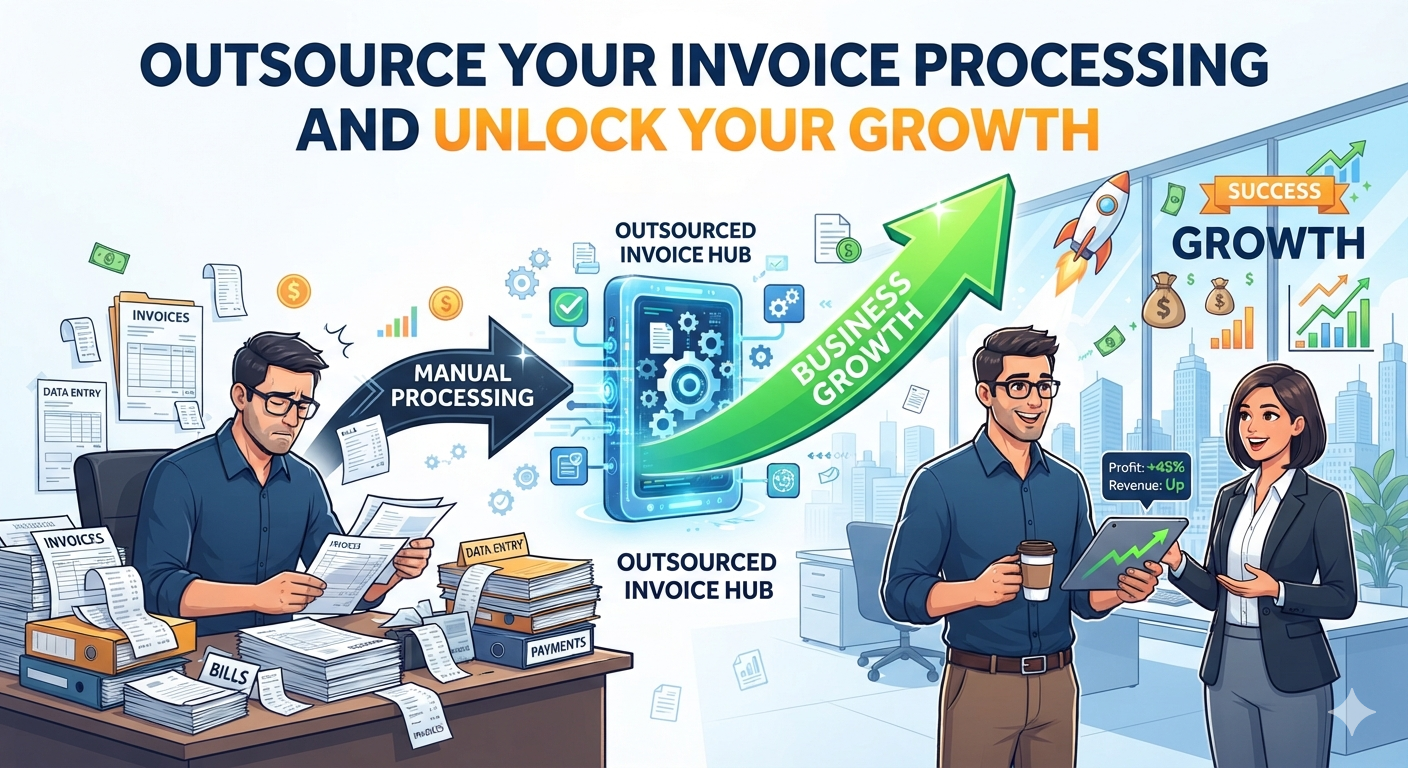

Outsource Invoice Processing To Focus on the Growth
As businesses look beyond domestic borders to capture new growth, expanding into global markets presents incredible revenue opportunities. However, it also introduces a massive web of administrative complexity. Among the most tedious operations is specifically invoice processing task. Here various sectors can take advantage to Outsource Invoice Processing to come out from bottlenecks.
Managing cross-border invoices involves navigating multiple currencies, various languages, complex international tax laws, and strict local compliance regulations. For growing enterprises, handling this internally can quickly bottleneck financial operations. This is why forward-thinking global organizations are leveraging a strategic solution to outsource invoice processing.
By partnering with specialized third-party providers, companies can transform a clunky back-office burden into a lean, scalable engine for global growth. Here is a detailed look at how outsourcing invoice processing drives success across global markets.
Get Advantage by Outsource Invoice Processing Services to Mastering Multi-Currency and Multi-Lingual Complexities
Operating globally means dealing with suppliers who invoice in different currencies and languages. An internal finance team trained primarily in local accounting practices can struggle to interpret foreign-language line items or accurately handle fluctuating exchange rates.
When you outsource to a global service provider, you gain access to multi-lingual professionals and advanced data extraction tools (like multi-lingual Optical Character Recognition, or OCR). These experts ensure that data is captured flawlessly, regardless of the language or layout of the invoice. Furthermore, automated systems integrate real-time exchange rates, minimizing manual calculation errors and ensuring that foreign vendors are paid accurately and on time. This consistency builds immense trust with global suppliers, securing your supply chain.
Ensuring Seamless Regulatory and Tax Compliance by Outsource Invoice Processing
One of the biggest hurdles in global trade is compliance. Tax structures like Value Added Tax (VAT) in Europe, Goods and Services Tax (GST) in Asia-Pacific countries, and varying sales taxes in the Americas demand absolute precision. To make matters more complicated, governments worldwide are aggressively rolling out mandatory e-invoicing frameworks (such as the Peppol network in Europe and strict digital clearance models in Latin America) to combat tax evasion.
Failing to comply with these fast-changing local mandates can result in severe financial penalties, audits, and operational delays. Invoice processing providers make it their core business to stay abreast of international tax codes and regulatory shifts. They ensure that every processed invoice adheres strictly to local digital signatures, clearance workflows, and tax formatting rules, effectively insulating your business from global legal risks.
Outsource Invoice Processing Helps to Achieve Scalability and Flexibility
Global expansion is rarely a linear journey. Businesses often experience seasonal spikes in transaction volumes, sudden growth from market penetration, or consolidated volume after an international acquisition. Building an internal team capable of handling peak invoice volumes requires heavy investments in hiring and training—investments that become costly overhead during slower quarters.
Outsourcing offers an elastic operational model. Whether your invoice volume doubles overnight due to a new overseas product launch or drops during an off-season, your outsourcing partner scales their resources accordingly. You only pay for what you process, transforming a rigid fixed cost into a highly flexible variable cost. This agility is vital for keeping global expansion lean and financially sustainable.
Accelerate Speed and Cycle Times by Outsource Invoice Processing
When managing international vendors, time zone differences can slow down communication and cause costly payment bottlenecks. A dispute over an invoice from a supplier in Tokyo might take days to resolve if your internal team is based in New York.
Outsourcing providers frequently utilize “follow-the-sun” operational models or strategic nearshore/offshore hubs. This means invoices are digitized, validated, and processed overnight or in the supplier’s native time zone. Faster cycle times allow global organizations to capitalize on early payment discounts offered by international vendors, while simultaneously avoiding late fees. Accelerated processing also provides leadership with real-time visibility into global cash flow, enabling better-informed liquidity management.
Mitigating International Fraud and Enhancing Security
Cross-border business transactions are prime targets for sophisticated financial fraud, including phishing, duplicate billing, and invoice tampering. Detecting these anomalies manually across hundreds of international entities is nearly impossible.
Specialized Invoice Processing outsourcing firms employ enterprise-grade cybersecurity measures and sophisticated AI-driven fraud detection systems. These tools automatically flag duplicate invoices, cross-reference vendor banking details against verified registries, and spot unusual billing patterns before a single dollar leaves your account. Combined with strict internal controls like segregation of duties and automated approval routing, outsourcing provides a powerful line of defense against global financial crime.
Refocusing Capital and Talent on Core Growth
Ultimately, the goal of expanding into global markets is to innovate, acquire customers, and outpace the competition. Spending valuable internal time, energy, and capital on manual data entry, tracking down missing paperwork, and fixing processing errors diverts focus away from your core mission.
Outsourcing invoice processing frees up your internal finance talent. Instead of acting as data entry clerks, your senior accountants and financial analysts can step into strategic roles—analysing market profitability, optimizing global capital allocation, and driving strategic partnerships.
Conclusion
In the modern global marketplace, operational efficiency is just as critical as product market fit. Managing international invoices manually is a legacy approach that hinders speed, increases risk, and strains vendor relationships. By outsourcing invoice processing, global enterprises gain the language skills, regulatory expertise, security, and scalability required to operate seamlessly anywhere in the world. It is not merely a cost-cutting tactic; it is a fundamental pillar of successful global expansion.