
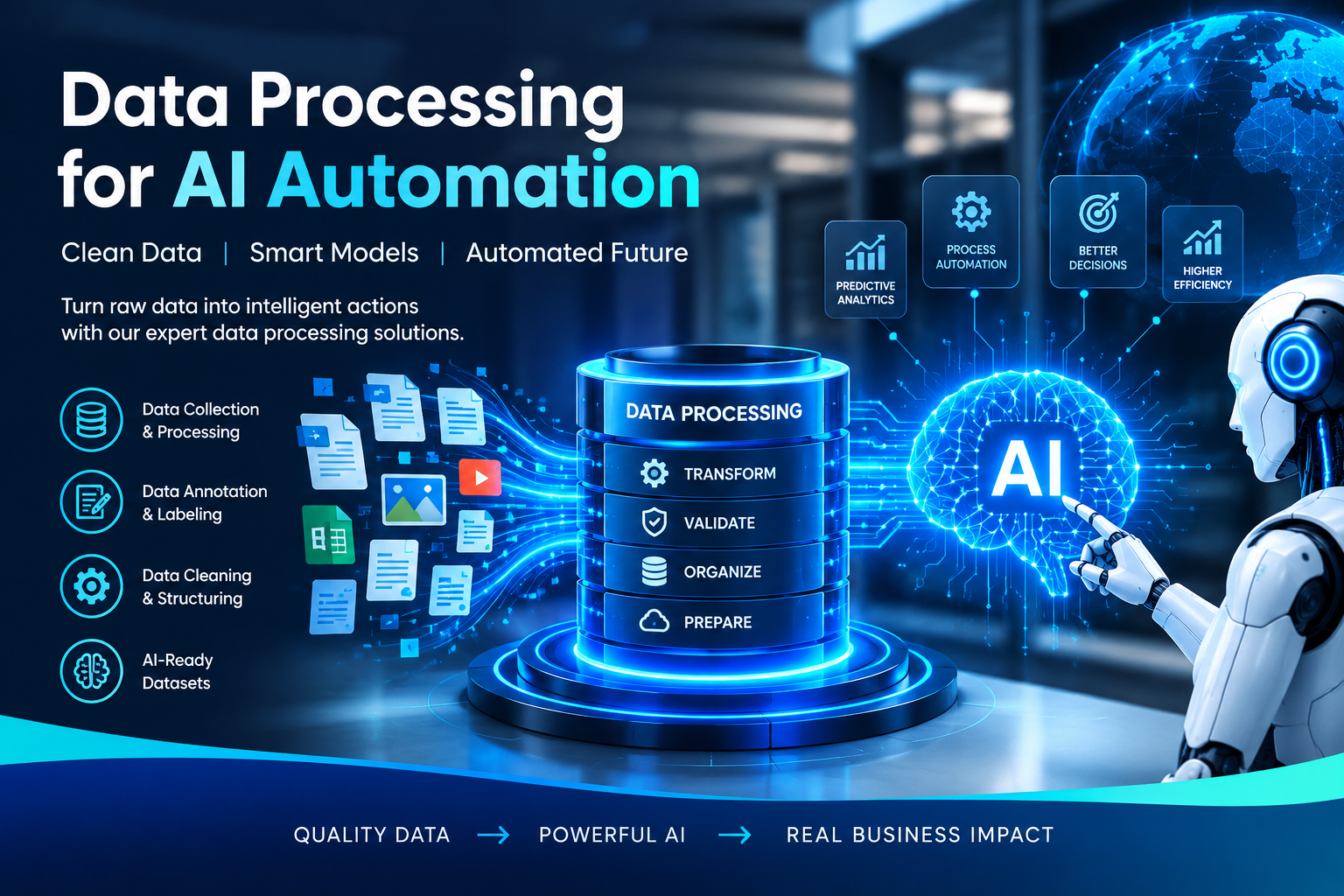

How Data Processing Is the Backbone of the AI Industry
Data Processing: The Backbone of the AI Industry
Artificial Intelligence (AI) is rapidly changing the way businesses operate, make decisions, interact with customers, and develop innovative products. From generative AI and machine learning to predictive analytics, computer vision, natural language processing, and intelligent automation, AI has become a critical technology across industries.
But behind every successful AI application is a resource that matters more than the algorithms themselves: high-quality data.
AI systems learn from data. They identify patterns, generate predictions, automate decisions, and produce intelligent outputs based on the information provided during training and operation. However, raw data is rarely ready to be used directly. It must be collected, organized, cleaned, classified, annotated, validated, enriched, and transformed into a usable format.
This is where data processing becomes the backbone of the AI industry
Businesses developing AI solutions increasingly rely on professional AI data processing services to prepare the datasets required for machine learning and artificial intelligence applications. At the same time, organizations are turning to Outsource Data Processing Services to manage large volumes of repetitive and complex data-related work efficiently and cost-effectively.
In this article, we explore why data processing is essential to AI, how data annotation and data cleansing support machine learning, and why outsourcing data processing can help AI-driven businesses scale faster.
Raw information can contain duplicate records, missing fields, inconsistent formats, incorrect values, irrelevant content, and other errors.
Data processing services help transform this raw information into a reliable dataset that can be used for business intelligence, analytics, automation, machine learning, and AI development.
Typical data processing activities include:
- Data entry
- Data extraction
- Data cleansing
- Data validation
- Data classification
- Data categorization
- Data annotation
- Data conversion
- Data enrichment
- Document processing
- Data quality checking
- Database management
For AI companies, these activities are particularly important because the quality of training and operational data can directly influence AI system performance.
Why Data Processing Is Critical for Artificial Intelligence
Artificial intelligence depends on data.
Machine learning algorithms analyze datasets to identify patterns and relationships. AI models use those patterns to make predictions, classify information, recognize objects, understand language, or generate content.
If the underlying data is incomplete, inconsistent, biased, incorrectly labeled, or poorly structured, the resulting AI system may produce unreliable outcomes.
This is why the principle “garbage in, garbage out” remains highly relevant to AI.
Even the most advanced AI model cannot magically turn fundamentally poor input data into consistently reliable intelligence.
Effective AI data processing services address this challenge by preparing datasets before they reach the model.
A typical AI data workflow may look like this:
Raw Data → Data Cleaning → Data Classification → Data Annotation → Data Validation → Structured Dataset → AI Training → Model Evaluation
Every stage contributes to the quality of the final AI system.
The Role of Data Processing in AI Training
AI models require training data to learn.
For example, an image recognition model may need thousands or millions of images. A natural language processing system may require large volumes of text. A speech recognition model may need extensive audio recordings and corresponding transcripts.
Before these datasets can be used, they often require substantial processing.
AI data processing teams may need to:
- Collect relevant information.
- Remove duplicate or irrelevant records.
- Correct formatting inconsistencies.
- Clean inaccurate information.
- Categorize datasets.
- Label or annotate data.
- Validate processed information.
- Remove inappropriate or unusable records.
- Standardize datasets.
- Prepare files for machine learning systems.
This makes AI data processing a critical component of the AI development lifecycle.
How Data Processing Supports Generative AI
Generative AI has significantly increased demand for high-quality data.
Large AI systems depend on extensive datasets during development, evaluation, and improvement. Preparing those datasets requires sophisticated data processing workflows.
Depending on the project, teams may perform:
- Document collection
- Text extraction
- Data cleaning
- Content classification
- Data filtering
- Metadata creation
- Data annotation
- Duplicate removal
- Quality control
- Sensitive-data identification
- Dataset validation
The objective is not simply to process more data. It is to create better-quality data that is relevant, consistent, and usable.
As generative AI adoption increases, businesses that can efficiently manage and process large datasets will have a significant operational advantage.
How Outsource Data Processing Services Support AI Companies
Managing large-scale data processing internally can require significant investment in people, technology, training, infrastructure, and quality management.
This is why many businesses choose to outsource data processing services.
An experienced outsourcing provider can support businesses with specialized teams for:
- Data entry
- Data cleansing
- Data extraction
- Data conversion
- Data annotation
- Data classification
- Document processing
- Data validation
- Research and data enrichment
- AI training data preparation
Outsourcing allows businesses to access additional processing capacity without necessarily expanding their permanent internal workforce.
Data Processing for Different AI Applications
The need for quality data processing extends across many AI applications.
Healthcare AI
Healthcare AI may rely on structured medical records, images, documents, and other information. Data processing can help organize and prepare these datasets for appropriate AI applications.
Financial AI
Financial institutions use AI for areas such as fraud detection, risk analysis, forecasting, and customer analytics. Accurate transaction and customer data is essential for these applications.
Retail AI
Retail businesses use AI for recommendation engines, customer analytics, inventory forecasting, demand prediction, and personalization.
Autonomous Technology
Computer vision and autonomous systems require large quantities of accurately labeled images and video. Data annotation services play a major role in preparing these datasets.
Customer Service AI
AI-powered customer service systems can depend on historical conversations, support tickets, FAQs, product information, and customer records.
Processing and categorizing this information can help create useful datasets for AI applications.
Data Security and Quality Control
As organizations process increasingly valuable information, data security and quality control become essential.
The Future of AI Data Processing Services
The demand for AI Data Processing Services is expected to grow as organizations adopt more AI technologies.
Several trends are likely to influence the future of data processing:
Greater Automation
AI and intelligent automation will increasingly handle repetitive processing tasks.
Larger Datasets
AI systems will continue to require large and diverse datasets for training and evaluation.
Higher Data Quality Standards
Businesses will place greater emphasis on accuracy, consistency, relevance, and traceability.
More Data Annotation
Computer vision, language AI, robotics, autonomous technology, and other AI applications will continue creating demand for high-quality annotated datasets.
Human-in-the-Loop Processing
Human professionals will continue to play an important role in reviewing, validating, and improving automated data workflows.
Increased Outsourcing
As organizations seek flexibility and cost efficiency, demand for Outsource Data Processing Services is likely to increase.
Frequently Asked Questions
What is data processing in AI?
Data processing in AI involves collecting, cleaning, organizing, classifying, annotating, validating, and preparing data for artificial intelligence and machine learning applications.
Why is data processing important for AI?
AI systems learn from data. High-quality data processing helps ensure that the information used to train and operate AI systems is accurate, consistent, relevant, and properly structured.
What are AI Data Processing Services?
AI Data Processing Services help businesses prepare and manage datasets for AI applications. Services may include data cleansing, annotation, classification, extraction, validation, conversion, and AI training data preparation.
What are Data Annotation Services?
Data Annotation Services involve labeling or tagging data such as images, text, audio, and video so AI and machine learning models can learn to recognize patterns and categories.
Why should businesses outsource data processing?
Outsourcing data processing can provide access to skilled professionals, scalable resources, faster turnaround, improved efficiency, and potential cost savings while allowing internal teams to focus on core business activities.
How does data cleansing help AI?
Data cleansing removes or corrects duplicate, inaccurate, incomplete, inconsistent, or irrelevant information, helping create more reliable datasets for AI and machine learning applications.
Can data processing be used for generative AI?
Yes. Generative AI projects can require extensive data collection, cleaning, filtering, classification, annotation, document processing, and validation to prepare suitable datasets.
What industries use AI data processing?
AI data processing is used across healthcare, finance, retail, e-commerce, logistics, manufacturing, automotive, customer service, technology, media, and many other industries.